
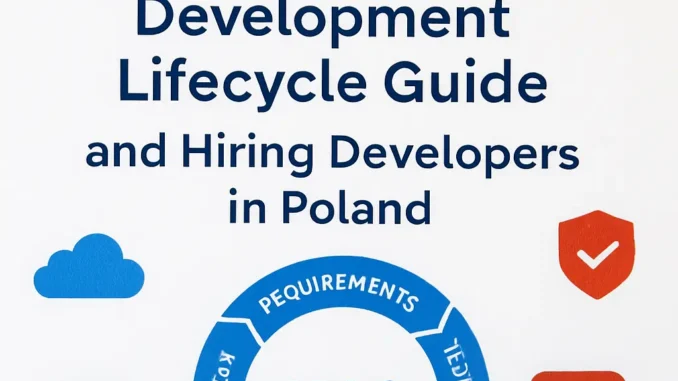
The way companies build software today is more strategic and structured than ever. Understanding the system development lifecycle and knowing when to involve a specialized partner can dramatically improve software quality, speed, and ROI. This article explores how modern businesses can combine SDLC best practices with a highly skilled dedicated development team poland to deliver robust, scalable solutions in a competitive digital market.
Aligning Business Goals with the System Development Lifecycle
The system development lifecycle (SDLC) is far more than a theoretical model; it is a practical roadmap for transforming business needs into reliable software systems. When properly understood and applied, SDLC aligns stakeholders, minimizes risks, and ensures that technology investments translate into measurable business outcomes. To get real value, however, organizations must interpret each phase in business terms, not just in technical jargon.
1. Requirements: Turning business strategy into technical intent
The requirements phase is where ambiguity is either resolved or cemented into the project’s DNA. Strong requirements engineering connects executive vision, operational constraints, and user expectations.
Key practices in this phase include:
- Stakeholder mapping: Identifying all relevant parties—executives, end‑users, operations, compliance, security—so no critical perspective is missed.
- Business process analysis: Documenting current workflows (as-is) and desired improvements (to-be) to avoid building software that simply digitizes existing inefficiencies.
- Defining measurable outcomes: Setting KPIs (e.g., reduce onboarding time by 30%, cut error rates by 40%) that will later be used to measure success.
- Prioritization frameworks: Using methods like MoSCoW (Must, Should, Could, Won’t) to align scope with budget and timeline.
Many projects fail not because the technology is flawed, but because the problem definition is incomplete. Mature organizations treat requirements as a continuous, living activity, especially when following agile or hybrid methodologies. This implies revisiting assumptions after early feedback, refining user stories, and constantly validating that evolving requirements still align with strategic objectives.
2. System design: Where concept becomes architecture
During the design phase, broad requirements are translated into technical architecture, data flows, and user experiences. The decisions made here significantly impact scalability, maintainability, and security for years.
Critical design dimensions include:
- Architecture style: Choosing between monolith, modular monolith, microservices, or event-driven architectures depending on scale, deployment complexity, and team maturity.
- Data strategy: Defining data models, integration points, master data management, and data governance to avoid later fragmentation.
- Security by design: Incorporating authentication, authorization, encryption, and logging requirements from the start, rather than retrofitting controls.
- UX and accessibility: Designing interfaces that improve user efficiency and comply with accessibility guidelines, directly influencing adoption rates.
Effective design is a negotiation: between short-term delivery pressure and long-term technical health. Organizations that oversimplify architecture often pay later with performance bottlenecks, integration headaches, and expensive refactoring. Conversely, overengineering can delay value realization. The most effective teams ground design decisions in realistic usage forecasts and total cost of ownership over several years.
3. Implementation: From blueprint to working software
Implementation is not just coding; it is the disciplined practice of converting design into high-quality, maintainable software. Mature teams use engineering practices that reduce defects, accelerate feedback, and improve knowledge sharing.
Foundational practices include:
- Version control discipline: Clear branching strategies, code review policies, and automated checks on pull requests.
- Test automation: Unit, integration, and end-to-end tests that guard against regression as the codebase evolves.
- Continuous integration: Automated builds and test runs with every change, providing early warning of integration issues.
- Code quality standards: Shared style guides, static analysis, and documentation standards to keep the codebase coherent as teams grow.
Implementation quality is heavily influenced by team composition and collaboration norms. Cross-functional teams—combining backend, frontend, QA, DevOps, and sometimes business analysts—are usually more effective than siloed groups that hand off work across organizational boundaries.
4. Testing: Building confidence, not just catching bugs
Testing within the SDLC is about risk management. The question is not “Does it work?” but “Under what conditions might it fail, and how severe would the impact be?” A robust testing strategy addresses functionality, performance, security, and usability.
A mature approach to testing includes:
- Risk-based test planning: Focusing effort on high-impact areas (payment flows, data integrity, compliance-critical features).
- Multi-layered testing: Unit, API, UI, performance, security, and compatibility testing.
- Test data management: Using realistic, privacy-compliant datasets to uncover issues that would not appear in trivial scenarios.
- Shift-left testing: Involving QA early, during requirements and design, to prevent defects instead of only detecting them later.
Testing also serves as a communication tool. Well-written test cases and acceptance criteria help align business expectations with development output, minimizing disputes at release time and reinforcing a shared understanding of “done.”
5. Deployment and integration: Moving safely into production
Deployment is no longer a one-time event at the end of a project. Continuous delivery and DevOps practices have transformed deployment into a frequent, low-risk activity—when implemented correctly.
Key elements of a resilient deployment strategy:
- Automation: Scripts and pipelines that eliminate manual, error-prone steps from build to production.
- Environment parity: Keeping development, staging, and production environments closely aligned to avoid “it works on my machine” issues.
- Progressive rollouts: Blue-green deployments, canary releases, or feature flags to minimize user impact if something goes wrong.
- Observability: Metrics, logs, and distributed tracing that allow fast detection and diagnosis of production anomalies.
Modern SDLC practices extend beyond deployment to cover how often changes are released, how quickly issues are resolved, and how well systems recover from failures. These factors directly inform business perceptions of IT reliability and agility.
6. Maintenance and evolution: Designing for change
Maintenance should be understood as continuous evolution, not mere bug fixing. The longest—and often most expensive—part of the SDLC is the operational lifespan of the system, during which requirements shift, user expectations grow, and technology stacks age.
Effective maintenance strategies consider:
- Technical debt management: Explicitly tracking shortcuts and refactoring needs to prevent them from crippling future progress.
- Backward compatibility: Managing API changes and data migrations in ways that do not unnecessarily disrupt users or integrations.
- Performance tuning: Monitoring real-world usage patterns and optimizing bottlenecks as traffic and data volumes grow.
- Lifecycle planning: Knowing when to enhance, when to replatform, and when to retire a system entirely.
Organizations that treat maintenance strategically are better able to respond to market shifts, regulatory changes, and new business models, turning their software platforms into long-term assets rather than liabilities.
Choosing and Integrating a Dedicated Development Team for SDLC Excellence
Understanding the SDLC is only part of the equation. Many organizations lack the internal capacity or specific expertise to execute it effectively at scale. This is where a dedicated development team becomes a powerful extension of the business, provided it is carefully selected, integrated, and managed to align tightly with SDLC practices and strategic goals.
1. Why dedicated teams fit complex SDLC-driven projects
A dedicated team model involves a stable group of professionals—developers, QA engineers, architects, DevOps specialists—allocated exclusively or primarily to a single client over an extended period. Unlike traditional outsourcing, which often focuses on delivering a fixed scope, dedicated teams emphasize long-term collaboration and domain understanding.
Advantages of the dedicated model for SDLC work:
- Continuity: The same people who worked on requirements and design remain available during implementation and maintenance, preserving context.
- Domain expertise: Over time, the team internalizes business rules, user behavior, and regulatory nuances, improving decision quality in every SDLC phase.
- Scalability: Capacity can be adjusted according to project phase—more engineers during implementation, more QA during testing, more DevOps around major releases.
- Process alignment: Teams can adopt the client’s SDLC standards (or co-create improved ones) rather than forcing a rigid vendor methodology.
For initiatives that span multiple years or multiple products, this continuity is crucial. It reduces onboarding overhead, avoids repetitive knowledge transfer, and accelerates the pace at which new features can be safely introduced.
2. Competency areas to look for in a dedicated SDLC partner
Not every external team is equally capable of supporting a full lifecycle approach. Evaluating candidates requires looking beyond basic technology stacks and rates, and examining how they structure and govern work.
Core competencies include:
- Requirements and analysis skills: Ability to facilitate workshops, work with user stories and use cases, and translate business needs into technical tasks.
- Architecture and design expertise: Comfort with modern architectures, integration patterns, and cloud-native principles, tailored to your constraints.
- Quality engineering culture: Demonstrated use of automated testing, CI/CD, code review norms, and measurable quality criteria.
- Security and compliance awareness: Experience working under industry-specific regulations (finance, healthcare, e-commerce) and embedding security within the SDLC.
- DevOps and operations: Skills to support deployment pipelines, infrastructure as code, and monitoring, not just development.
Reference projects, certifications, and technical interviews help validate these claims, but long-term success depends equally on cultural fit: communication style, transparency, and willingness to share responsibility for outcomes.
3. Integrating a dedicated team into your SDLC
Even highly skilled teams can underperform if integration into the client’s SDLC is weak. The goal is to create one blended delivery organization, not two parallel groups that send documents back and forth.
Practical integration strategies:
- Unified ceremonies: Daily standups, sprint planning, refinement, and retrospectives should include both internal and external team members, with clearly defined roles.
- Shared tools and repositories: Everyone works in the same issue tracker, version control system, documentation space, and CI/CD pipelines.
- Clear ownership boundaries: Define which components, environments, and processes each side owns, but avoid micromanagement through excessive handoffs.
- Transparent metrics: Track lead time, cycle time, defect rates, deployment frequency, and SLA adherence across the entire blended team.
Successful integration turns the SDLC into a single, coherent process where location and employment contract become invisible in day-to-day collaboration. Communication practices, not technology, usually determine how seamless this feels.
4. Governance and risk management across the lifecycle
Outsourcing any part of SDLC work introduces risks around quality, security, and continuity. These can be effectively managed through structured governance that focuses on outcomes rather than micromanaging tasks.
Elements of a strong governance model:
- Joint steering committees: Regular meetings where senior stakeholders from both sides review roadmap, risks, and performance indicators.
- Escalation paths: Clear mechanisms to resolve blockers, disagreements, or priority conflicts quickly.
- Contractual alignment: SLAs and KPIs tied to business outcomes (uptime, incident response times, feature throughput), not only hours worked.
- Knowledge retention: Documentation practices, cross-training, and rotation plans to ensure that key knowledge is not concentrated in a single individual.
When governance is embedded into SDLC phases—requirements sign-offs, design reviews, release approvals—risks are surfaced early, and corrective actions are more economical.
5. Continuous improvement and feedback loops
A major advantage of combining SDLC discipline with a dedicated team is the ability to evolve both the product and the process over time. This requires intentional feedback loops.
Improvement mechanisms can include:
- Retrospectives with real data: Reviewing past sprints or releases using metrics, not just opinions, to identify systemic issues.
- User-centric feedback: Incorporating analytics, user testing, and stakeholder interviews into backlog refinement.
- Experimentation culture: Trying out changes to estimation methods, branching strategies, or test coverage and measuring their impact.
- Learning investments: Allocating time for the team to explore new tools and practices that may enhance future SDLC phases.
Over time, these practices can transform the relationship from a simple delivery arrangement into a strategic partnership, where both sides contribute to not only building software but also refining how software is built.
Conclusion
Sustainable software success requires more than isolated technical decisions. It demands a holistic understanding of the system development lifecycle and disciplined execution at every phase, from requirements to long-term maintenance. By pairing SDLC best practices with a deeply integrated dedicated development team, organizations can gain speed, quality, and strategic flexibility, transforming software from a cost center into a lasting competitive advantage that adapts as the business evolves.